
School floor sanding in Sutton KT17
School floor sanding in Sutton KT17 needs careful planning, particularly when classrooms, assembly halls and corridors must be ready for children and staff at the start of term. Years of chair movement, muddy footwear, cleaning chemicals and daily foot traffic gradually break down protective lacquer. Once the seal wears through, timber absorbs dirt and moisture, leaving rough boards, unhygienic joints and potential slip or trip hazards.
We provide School Floor Restoration in Sutton for nurseries, primary and secondary schools, academies, independent schools, colleges and educational premises throughout the Sutton and Ewell area. Whether the job involves a Victorian school hall with old pitch pine boards or a modern teaching block with engineered oak flooring, the specification must suit the timber, expected traffic and available closure period.
Our approach to School Floor maintenance in Sutton starts with assessing the existing surface rather than automatically recommending complete sanding. Where the timber is structurally sound, School Floor Refinishing in Sutton can restore protective performance without unnecessary removal of valuable wood. Call 0800 335 7565 to discuss site inspections, holiday works and out-of-hours restoration.
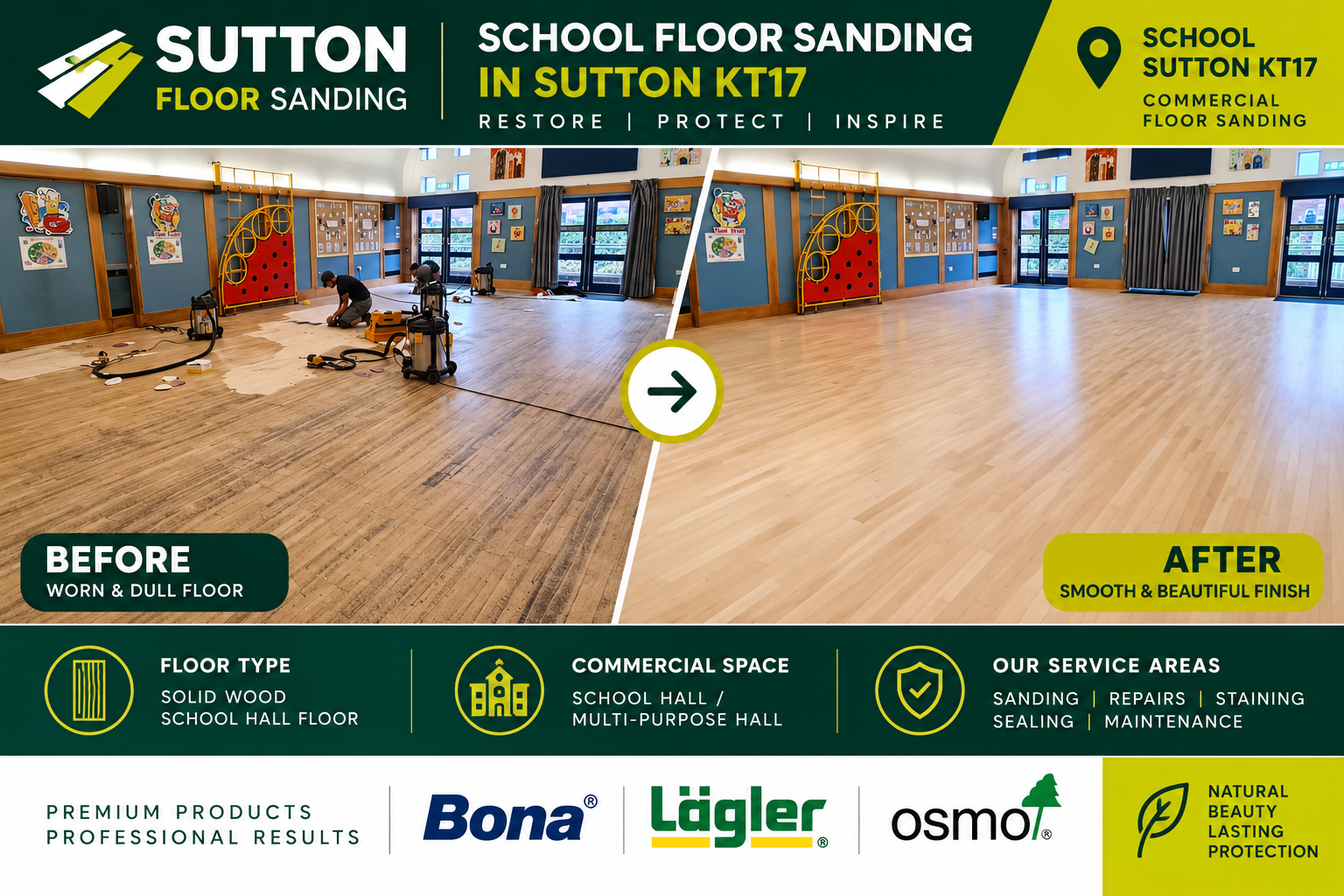
Before and after school hall floor sanding in Sutton KT17, transforming a worn wooden floor into a clean, smooth finish with professional sanding and restoration.
School Timber Floors in Sutton KT17: Wear, Damage and Safety Concerns
School floors take punishment that domestic timber flooring rarely experiences. Assembly chairs are dragged across the same sections every morning, classroom furniture wears through lacquer around desk legs, and entrance corridors collect abrasive grit from playgrounds. Repeated damp mopping and unsuitable cleaning chemicals can soften or dull an ageing coating, particularly where the protective film is already compromised.
Across Ewell Village, near Bourne Hall, Ewell High Street and the Sutton–Cheam boundary, educational properties occupy everything from converted Victorian buildings to Edwardian institutional blocks and post-war school campuses. Older halls can contain narrow pitch pine or quartersawn oak boards fixed over suspended timber structures. These floors often require localised repairs and careful sanding rather than aggressive stock removal.
Ordinary DIY floor sanders and supermarket varnishes are not suitable substitutes for a properly specified commercial restoration system. A badly levelled floor may look acceptable under artificial lighting but expose sanding ripples in daylight, while an unsuitable polish can leave a slippery film or interfere with the adhesion of future lacquer coats.
Common Timber Flooring Defects in Educational Buildings
- Open joints and dirt traps: Gaps between ageing boards collect dust, food debris and moisture, making effective cleaning more difficult in classrooms, nurseries and childcare facilities.
- Worn lacquer and inconsistent grip: Polished traffic lanes, contaminated coatings and incorrect maintenance products can alter slip resistance, especially near entrances and washroom approaches.
- Moisture ingress: Water entering through exposed joints can cause swollen board edges, dark staining, cupping and deterioration of timber fixings.
- Loose parquet blocks: Failed adhesive beneath woodblock flooring can produce movement, hollow patches and raised edges that become trip hazards.
- Splintering and exposed fixings: Raised grain, damaged boards and protruding nails require attention before the floor is returned to use by pupils.
- Surface contamination: Silicone polishes, wax residues and incompatible cleaning agents can compromise the bond of a new finishing system.
In nursery rooms and special educational needs facilities, the condition of the finished floor deserves particular attention. Children may spend considerable time sitting or playing directly on the surface, while mobility equipment and wheeled furniture can put concentrated pressure on joints and individual boards. The aim is a cleanable, stable and fit-for-purpose floor, not simply a shinier one.
Our Five-Stage Commercial School Floor Restoration Process
Every site needs its own method statement. Before machinery arrives, we establish the timber construction, condition of the existing finish, extent of repairs and time available between the final coat and the building reopening. The work is then divided into manageable stages so the headteacher, estates manager or facilities contractor knows which rooms are available and when.
Step 1: Subfloor Audit, Timber Identification and Moisture Testing
We begin by checking board stability, existing coating thickness, perimeter movement, damaged areas and signs of trapped moisture. Timber species identification matters: quartersawn oak, pitch pine and teak behave differently under abrasives and finishing products. Oily or extractive-rich species may need additional preparation and compatibility testing before lacquer application.
Where accessible and appropriate, subfloor conditions are assessed using calibrated hygrometers, in-situ relative humidity checks and timber moisture meters. A concrete subfloor giving an excessive moisture reading cannot simply be sealed beneath a new timber finish. Likewise, cupped boards should not be sanded flat until the underlying moisture problem has been investigated.
Older school buildings near Ewell Village and the surrounding conservation areas may contain suspended timber floors with limited ventilation or historic repair work beneath the boards. We look for evidence of movement, damp and previous patch repairs before deciding how much material can safely be removed.
Step 2: Timber Repairs, Re-bonding and Resin-Slurry Gap Filling
Loose boards are secured, damaged sections are repaired and unstable parquet blocks are lifted where necessary. For suitable parquet installations, a compatible silane-based flexible parquet adhesive can provide a resilient bond while accommodating normal timber movement. Adhesive selection depends on the substrate, block construction and manufacturer’s technical requirements.
Small, stable joints can be treated with resin-slurry gap filling, using clean fine sanding dust mixed with a compatible flooring resin. This produces a reasonably close colour match without leaving obvious pale filler lines across the floor. Wider seasonal gaps in moving floorboards often require timber slips or another repair method, because rigid filler alone is liable to crack out.
In school halls containing old pitch pine, we also check for exposed nail heads and resin-rich patches that may affect coating adhesion. Rotten or structurally weakened boards are replaced where required; they are not disguised with filler. Any historic building restrictions or conservation requirements are considered before significant alterations.
Step 3: HEPA Dust-Controlled Sanding and Surface Preparation
For larger solid timber floors, the Lägler Hummel belt sander provides controlled cutting across worn lacquer and uneven boards. Edge sanding and detail work around skirtings, radiators, door frames and fixed furniture follow separately. Abrasive grades are selected to suit the floor’s condition, generally progressing from coarse removal through intermediate cuts to a suitable final finish.
Dust management is particularly important in operating schools. Suitable machinery is connected to professional extraction equipment, with HEPA H14 filtration specified where the dust-control assessment requires it. Work areas are isolated, ventilation is assessed and cleaning is completed before the application of finishing products.
No sanding operation is completely dust-free. We therefore plan containment, extraction and final cleaning around classrooms, IT equipment, books, ventilation grilles and adjacent occupied areas. Where older coatings or suspect materials are encountered, the appropriate assessment comes before abrasive removal.
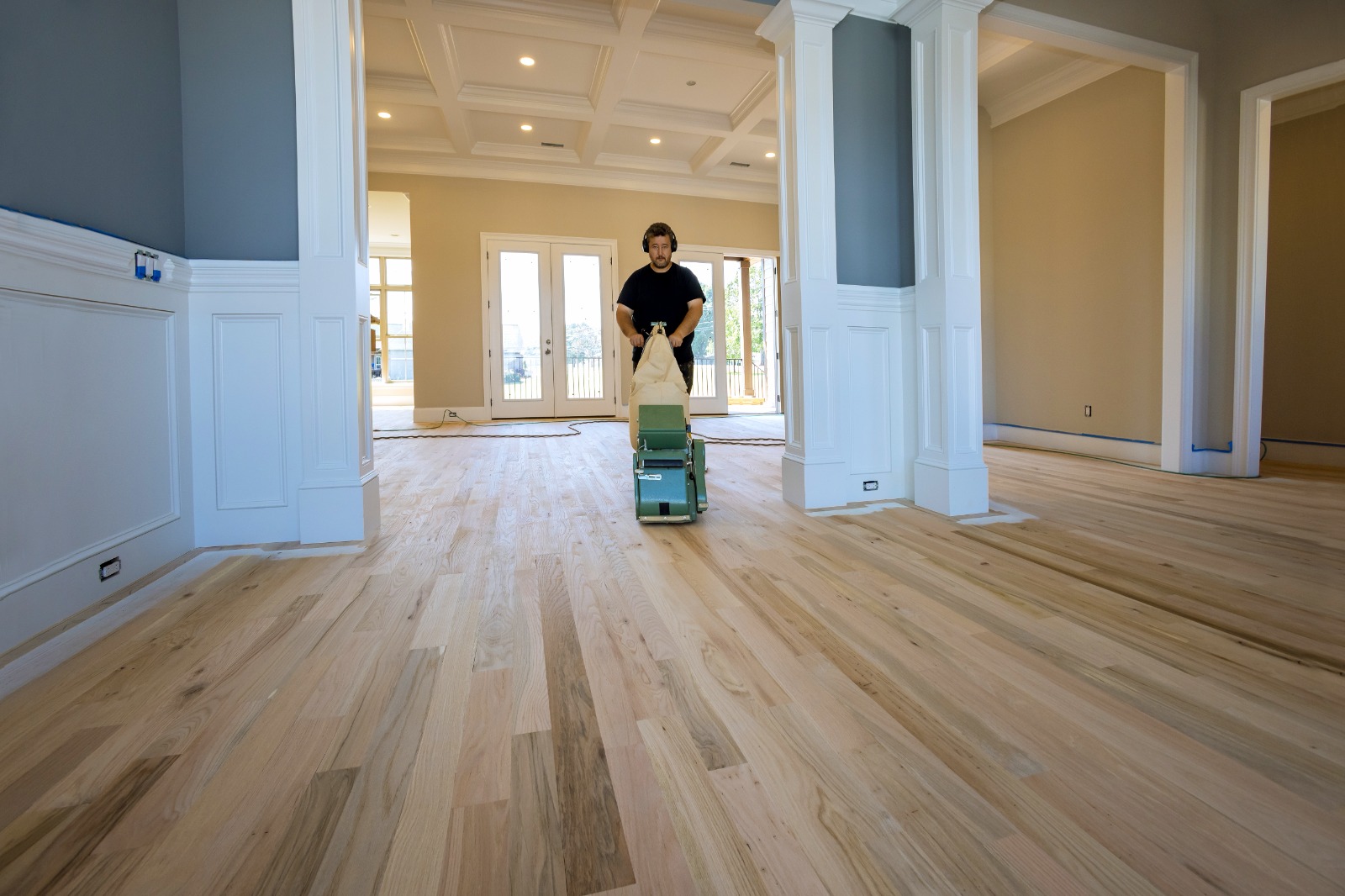
Professional floor sanding and wood floor restoration in Sutton, restoring timber floors to a smooth, natural finish.
Step 4: High-Traffic Lacquers, Hardwax Oils and Slip-Resistant Finishes
For heavily used classrooms, corridors and assembly halls, a professional 2K waterborne polyurethane lacquer is often the practical choice. These systems use a measured cross-linking catalyst or hardener to improve the cured coating’s resistance to abrasion and chemical wear. Application rates, mixing ratios, working time and recoating intervals must follow the manufacturer’s technical data sheet.
One suitable product family to consider is Bona Traffic HD, a two-component waterborne finish developed for high-traffic timber floors. For certain heritage floors, staff rooms and suitable lower-traffic settings, Osmo Polyx-Oil Anti-Slip may offer an alternative where an oil-based maintenance system is appropriate.
Finish selection is not based on appearance alone. We consider abrasion resistance, cleaning chemicals, potential moisture exposure, the required level of slip resistance and any sports-floor performance requirements. Nurseries and teaching spaces may also benefit from systems supported by suitable low-emission documentation, including EMICODE EC1 Plus ratings where applicable to the specific product.
Slip resistance can be assessed using wet and dry pendulum testing to BS EN 16165:2021 Annex C, which replaced the former BS 7976-2 method. Where relevant, a wet Pendulum Test Value of 36 or above is commonly used as a low-slip-potential benchmark, although the required performance depends on the actual risk assessment. We would not claim that any lacquer is automatically slip-safe without suitable evidence for the complete finished system.
For school sports halls, an ordinary classroom lacquer should not be specified without checking the required sporting characteristics. Facilities used for basketball, badminton, dance or indoor PE may need a sports-floor system assessed against BS EN 14904 and the relevant slip, friction and performance criteria.
Step 5: Aftercare, Cleaning and Planned Maintenance
A restored timber floor will only perform properly if the cleaning regime suits its coating. Strong alkaline cleaners, bleach-based products, soaking-wet mops and incompatible polishes can damage finishes or leave unwanted residues. We recommend a neutral, manufacturer-approved cleaner, controlled damp cleaning and effective entrance matting to reduce grit.
School estates teams should inspect entrances, chair movement zones and heavily trafficked corridors regularly. Replace worn furniture feet, address spills promptly and arrange a maintenance coat before traffic wears completely through the existing lacquer. On an oiled floor, compatible maintenance oil may be preferable to allowing exposed timber to deteriorate.
A practical school timber floor maintenance programme can include periodic condition surveys, localised repairs, surface cleaning and re-coating during school closures. This reduces the likelihood of needing a full bare-wood sanding cycle every time the floor begins to look tired.
Out-of-Hours School Floor Sanding Without Unnecessary Disruption
Restoration work inside an educational building must fit around safeguarding procedures, room bookings, contractor access and the teaching timetable. A nursery cannot lose its main activity room without an agreed alternative, and an academy cannot simply close every corridor while pupils move between lessons. Delivery routes, equipment storage, fire exits and access to neighbouring classrooms all need planning before work begins.
Where practicable, we plan sanding and coating around half-term breaks, summer holidays, weekends or agreed evening access. The critical point is the finishing schedule: sanding a hall overnight is one thing, but allowing sufficient drying and curing time before hundreds of children walk across it is another.
| Working Shift | Operational Benefits | Suitable Facilities |
|---|---|---|
| Overnight | Permits isolated preparation or repair work outside teaching hours, subject to noise restrictions, drying times and safe segregation. | College teaching rooms, administrative areas, training centres and selected school corridors. |
| Weekend Phased | Provides a longer closure window for sanding, repairs, coating and initial drying before planned reopening. | Primary school halls, independent schools, music rooms and educational offices. |
| Sectional | Allows suitable rooms or zones to be isolated while other parts of the premises remain in use. | Large academies, university buildings, sixth-form colleges and multi-building campuses. |
Some lacquer systems permit light use after several hours under controlled conditions, while others require a substantially longer period before normal traffic. For example, Bona Traffic HD publishes rapid return-to-traffic performance under specified conditions, but actual handover still depends on temperature, humidity, ventilation, coat build and site circumstances. Heavy furniture, protective coverings and wet cleaning may need to be delayed beyond the initial walking time.
We establish the proposed reopening date before selecting the finishing system. If the programme does not allow adequate drying or curing, the sensible approach is to change the work schedule rather than risk premature damage to the new surface.
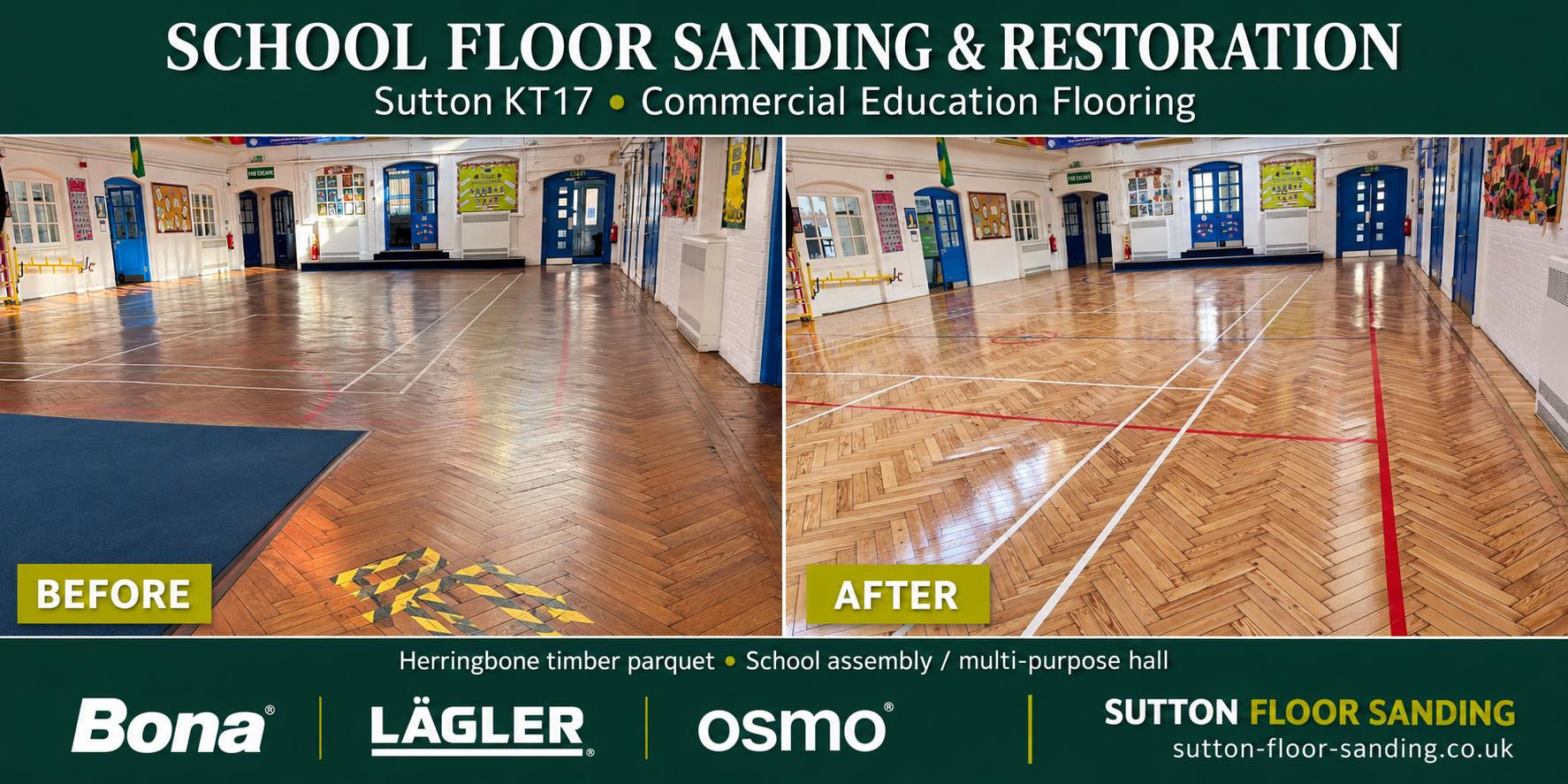
Before and after school floor sanding and restoration in Sutton KT17. Herringbone timber parquet flooring in a school assembly hall, professionally sanded and refinished by Sutton Floor Sanding.
Health, Safety and Contractor Management on School Sites
School restoration is managed as commercial construction and maintenance work, not an ordinary domestic decorating job. Access arrangements, segregation, fire precautions, dust exposure and chemical handling should be considered alongside the school’s safeguarding and contractor policies. No teaching area should be handed back with exposed fixings, sanding debris, uncontrolled chemical residues or unfinished access routes.
Site documentation and controls may include:
- RAMS: Site-specific Risk Assessments and Method Statements covering sanding, repairs, finishing, access and waste handling.
- COSHH: Assessments for lacquers, hardeners, adhesives, cleaners and wood-dust exposure, supported by relevant safety data sheets.
- Dust control: Appropriate extraction, filtration, respiratory protection and housekeeping measures, reflecting HSE guidance and relevant workplace exposure requirements.
- Slip assessment: Review of the intended floor use, cleaning regime and, where required, pendulum testing under BS EN 16165:2021.
- Product emissions: Review of technical data, VOC information and applicable EC1 Plus low-emission certification where specified.
- Site access: Verification of applicable CSCS competence, insurance documentation, safeguarding requirements and any necessary DBS checks before commencement.
Where a school requests CSCS-carded operatives or evidence of commercial public liability insurance, those requirements should be confirmed during contractor prequalification and documented before the work is awarded. We recommend agreeing responsibilities for opening and securing the premises, emergency access, alarm systems and waste removal in writing.
School Floor Sanding for Different Educational Facilities
There is no single floor specification that suits every teaching environment. An oak-floored sixth-form common room experiences different wear from a nursery playroom, while a parquet entrance hall may need considerably more repair work than a modern engineered timber classroom.
- Nurseries, preschools, Montessori schools and childcare centres: Smooth, readily cleanable finishes with particular attention to spills, exposed joints, product emissions and child contact with the floor.
- Primary and secondary schools: Hard-wearing coatings for assembly halls, classrooms, corridors, libraries and dining areas subject to constant furniture movement.
- Private, independent and boarding schools: Careful restoration of original parquet, traditional oak boards and timber floors in older institutional buildings.
- Academies, sixth-form colleges and universities: Planned sectional works coordinated with examinations, teaching periods, maintenance shutdowns and estates schedules.
- Special educational needs schools: Attention to consistent floor levels, mobility aids, surface grip, cleaning requirements and safe room access.
- Music, art, dance and sports academies: Finishes selected around room-specific abrasion, acoustic, movement and sporting performance requirements.
- Tuition centres, language schools and adult learning facilities: Practical evening, weekend and holiday programmes to reduce disruption to occupied premises.
Vocational training centres, technical institutes, international schools and multi-use education campuses may have additional loading, access or operational requirements. These are assessed during the survey rather than assumed from the type of building.
Local School Floor Restoration Across Sutton, Ewell and KT17
Although KT17 is chiefly associated with Ewell and parts of Epsom, it sits close to Sutton, Cheam and the wider south-west London boundary. The local building stock includes older educational premises around Ewell Village and Church Street, inter-war school buildings, modern extensions and converted Victorian properties. Each can present different timber construction, ventilation and access conditions.
Properties near Ewell High Street, Bourne Hall, Ewell East, Ewell West and the roads towards Cheam may involve restricted delivery access or limited parking for commercial sanding equipment. We establish unloading arrangements, electrical supply, working hours and waste routes during the survey. For larger campuses, the sequence of individual buildings can be included in the quotation.
We also discuss the condition of adjoining timber skirtings, thresholds and door clearances. Taking too much material off an ageing floor can expose fixings or create awkward level changes, particularly where previous restorations have already reduced the available sanding depth.
School Floor Sanding Costs and Commercial Quotations
School floor sanding prices depend on more than the total square metreage. A clear, open assembly hall is usually quicker to prepare than several furnished classrooms with fixed cupboards, radiators and substantial parquet repairs. Existing lacquer thickness, timber condition, access restrictions, required finish and working hours all influence the quotation.
For an initial estimate, send clear photographs or a short video showing the whole floor, damaged sections, entrance thresholds and approximate room dimensions. A physical site survey can then establish the required repairs, moisture condition, coating specification and realistic programme.
You can review our floor sanding prices for general budgeting information and browse the floor sanding gallery for examples of timber floor finishes. Commercial school quotations are prepared to reflect the actual condition and operational requirements of the premises.
What Should Be Included in a School Flooring Quotation?
- Measured floor area and the rooms or zones included in the scope.
- Board repairs, parquet re-bonding and any proposed gap-filling method.
- Sanding preparation, dust containment and cleaning arrangements.
- Proposed primer, lacquer or oil system, including the number of coats.
- Out-of-hours labour, site access and any agreed programme restrictions.
- Indicative drying periods, final inspection and handover arrangements.
- Clearly identified exclusions and any repair items requiring further investigation.
A written specification is particularly useful for school business managers, facilities contractors and procurement teams comparing tenders. It makes clear whether contractors have allowed for the same repair standard, finishing system, site controls and reopening requirements.
Why Choose a Properly Specified Commercial Timber Restoration Service?
Good floor restoration is largely about decisions made before the first sanding belt touches the boards. Identifying the timber, checking moisture, selecting compatible products and allowing sufficient curing time all affect how the floor performs under daily school use. Cutting corners at these stages can leave a superficially attractive finish that fails far too early.
Our quotation approach centres on a photo or video-based initial assessment followed, where required, by a physical site survey. Commercial clients can establish the proposed scope, programme, required contractor credentials, insurance evidence and handover arrangements before authorising the work.
Whether the requirement is a complete bare-timber restoration, local parquet repairs or a planned maintenance coat, the objective remains the same: a sound, cleanable floor with a finish suitable for the building and its daily use.


